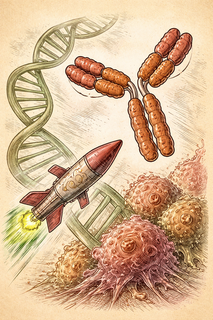
This study looks at advanced colorectal cancer, where targeted therapy still too often feels like showing up to a warehouse fire with a stylish spray bottle. The star drug here is a TROP2-directed antibody-drug conjugate, or ADC, called IMMU132, better known as sacituzumab govitecan. ADCs are the oncology version of a guided missile: an antibody finds a target on the cancer cell, then delivers a toxic payload. In this case, the payload is SN-38, the active metabolite of irinotecan, which damages DNA by inhibiting topoisomerase I.
That part is already useful. The more interesting bit is the plot twist.
The authors report that IMMU132 does not just damage DNA. It also seems to suppress the PERK-eIF2alpha-ATF4 arm of the unfolded protein response, which is one of the cell’s emergency stress programs. Translation: when cancer cells get rattled, they often run to a biochemical panic room called ER stress adaptation. PERK helps them keep it together. So if you hit the DNA and block the panic room door, the tumor has a worse day.
Then the team adds a PERK inhibitor, GSK2606414, and sees stronger antitumor effects across preclinical colorectal cancer models. Mechanistically, the combo further suppresses both ER stress signaling and Wnt/beta-catenin, which is a pathway colorectal cancer treats like a long-term subscription it forgot to cancel.
Why That Matters More Than It Sounds
Colorectal cancer is basically the Wnt pathway’s favorite group project. In many tumors, Wnt/beta-catenin signaling drives growth, survival, stem-like behavior, and treatment resistance. It is one of those pathways that everyone wants to target and no one has found easy to target cleanly in the clinic. Biology, as usual, read the brief and chose chaos instead.
So this paper is appealing because it does not try to punch Wnt directly in the face. Instead, it appears to hit the support beams holding up resistance. That is often how real progress happens. Not with a cinematic one-shot knockout, but by cutting off the exits.
There is also a practical clinical point here. TROP2 is a credible target in solid tumors, and TROP2-directed ADCs are no longer a niche curiosity. As of January 17, 2025, datopotamab deruxtecan was FDA-approved in metastatic HR-positive, HER2-negative breast cancer, and TROP2-directed ADC development kept expanding after that. In colorectal cancer, though, this whole class is still very much in the “interesting, promising, not-ready-for-prime-time” phase. An ongoing metastatic CRC trial called TROPHIT1 is testing sacituzumab govitecan beyond second line, which tells you the field sees a real opening here. It also tells you we are still collecting the alibis, not handing down the verdict.
The Good News, With the Required Trialist Side-Eye
The good news is that the paper gives a rational combination strategy. Not “add random drug and pray,” which, to be fair, has occasionally been disguised as innovation. It links payload biology, stress adaptation, and Wnt signaling into one resistance story. That is the kind of mechanistic coherence trial people like, because it offers a real hypothesis for patient selection and biomarker work later.
The side-eye part is simple: this is preclinical. Synergy in cell lines and animal models is not the same as benefit in people. Also, GSK2606414 is a tool compound with known toxicity concerns, especially pancreatic toxicity in prior preclinical work, so nobody should confuse “interesting PERK biology” with “clinic-ready regimen tomorrow morning.” Those are not the same species.
Still, the core idea is strong. If resistance to a TROP2 ADC partly depends on a stress-response escape hatch, then combining the ADC with a safer PERK-pathway strategy, or a related way of disrupting that adaptive program, could be a smart next move. That could matter most for patients with microsatellite-stable metastatic colorectal cancer, where therapeutic miracles remain in short supply and most treatment plans eventually become a polite argument with progression.
The Real-World Upshot
If these findings hold up, this kind of combination could do something oncologists always want and tumors deeply resent: turn an initially clever drug into a harder-to-escape trap. Not because it kills harder in some abstract way, but because it blocks the tumor’s backup plan.
Cancer cells are annoyingly good at improvisation. This study’s contribution is to suggest that one improvisation route in advanced colorectal cancer may run through PERK and Wnt-linked stress adaptation. Shut that down while the ADC is already delivering SN-38, and the cancer may finally run out of excuses.
That is not a cure. It is not even a clinical result yet. But it is the sort of preclinical logic that can lead to a trial worth opening, which in oncology is often where the real story starts.
References
-
Liu J, Li M, Huang J, et al. Overcoming ADC resistance in advanced colorectal cancer by dual targeting of TROP2 and PERK to suppress Wnt/beta-catenin signaling. Cell Reports Medicine. 2026; DOI: 10.1016/j.xcrm.2026.102769
-
Nelson BE, Meric-Bernstam F. Leveraging TROP2 Antibody-Drug Conjugates in Solid Tumors. Annual Review of Medicine. 2024;75:31-48. DOI: 10.1146/annurev-med-071322-065903
-
Bardia A, Messersmith WA, Kio EA, et al. Sacituzumab govitecan, a Trop-2-directed antibody-drug conjugate, for patients with epithelial cancer: final safety and efficacy results from the phase I/II IMMU-132-01 basket trial. Annals of Oncology. 2021;32(6):746-756. DOI: 10.1016/j.annonc.2021.03.005
-
Wang Y, Lu K, Xu Y, et al. Antibody-drug conjugates as immuno-oncology agents in colorectal cancer: targets, payloads, and therapeutic synergies. Frontiers in Immunology. 2025;16:1678907. DOI: 10.3389/fimmu.2025.1678907 PMCID: PMC12620403
-
Nieto-Jimenez C, Sanvicente A, Diaz-Tejeiro C, et al. Uncovering therapeutic opportunities in the clinical development of antibody-drug conjugates. Clinical and Translational Medicine. 2023;13(9):e1329. DOI: 10.1002/ctm2.1329 PMCID: PMC10517221
-
Geng J, Guo Y, Xie M, et al. Characteristics of endoplasmic reticulum stress in colorectal cancer for predicting prognosis and developing treatment options. Cancer Medicine. 2023;12(10):12000-12017. DOI: 10.1002/cam4.5874 PMCID: PMC10242314
Disclaimer: The image accompanying this article is for illustrative purposes only and does not depict actual experimental results, data, or biological mechanisms.