Preventive medicine has a warehouse problem. You can design a lovely screening program with all the polished signage and managerial optimism of a new airport terminal, but if the test kit never makes it from the loading dock to your bathroom and back to the lab, the whole thing is just expensive set design.
That is the question sitting underneath “Mailed Colorectal Cancer Screening Outreach - In-House or Outsourced?” by Brender, Richman, and Gross. This JAMA Internal Medicine piece is a short, sharp commentary on a related trial that compared two ways to get stool-based colorectal cancer screening into people’s hands: clinics could run the outreach themselves with mailed FIT kits, or they could lean on a manufacturer-run FIT-DNA system that handled more of the chasing, nudging, and administrative plumbing for them (Brender et al., 2026).
The Blueprint Was Simple. Real Life Was Not.
Colorectal cancer is still the second leading cause of cancer death in the United States, and the American Cancer Society estimates 158,850 new cases and 55,230 deaths in 2026 (ACS, 2026). The nasty part is that this is one of the more preventable cancers if you actually catch the troublemakers early. Polyps are basically bad renovations with terrible long-term consequences.
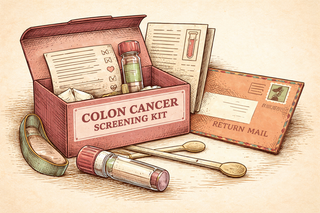
Stool-based tests exist because not everyone is thrilled to pencil in a colonoscopy between errands. A FIT checks for tiny amounts of blood in stool and is usually done yearly. A FIT-DNA test adds DNA markers from abnormal cells and is typically done every 3 years. Both are easier to complete at home than a colonoscopy, which is why they matter so much in community health centers and other safety-net settings where time, transportation, insurance, and life in general tend to behave like hostile zoning boards (CDC; USPSTF, 2021).
In-House Mailroom or Outsourced Concierge?
The trial behind this commentary, the CARES pragmatic cluster randomized clinical trial, enrolled 5,127 screening-eligible adults in community health centers in Boston and Los Angeles. The in-house model mailed FIT kits with automated text reminders from study staff. The outsourced model mailed FIT-DNA kits with the manufacturer’s own phone, text, and email follow-up system. Think local building superintendent versus full-service property management firm with a call center and a reminder algorithm (May et al., 2026).
The outsourced option won on completion. At 90 days, screening participation was 27.9% with FIT-DNA versus 22.6% with FIT. At 180 days, it was 31.7% versus 26.7%. That is not a cinematic blowout, but in population screening, a few percentage points can represent a lot of actual people who might avoid a late cancer diagnosis.
Brender and colleagues make the practical point that this is not just a test comparison. It is an operations comparison. FIT is cheap, but clinics have to do more of the labor. FIT-DNA is pricier, but some of the outreach machinery gets shifted to the manufacturer. In plain English: the building still needs maintenance, but someone else is handling the front desk.
The Awkward Part Nobody Gets to Skip
Here comes the part where the ceiling leaks.
A positive stool test is not the finish line. It is the fire alarm telling you to go inspect the building. In the CARES trial, only 36% of people with an abnormal stool result completed a follow-up colonoscopy within 180 days, even with navigation support (May et al., 2026). That is the sort of number that makes a health services researcher stare into the middle distance.
This is also where the commentary earns its keep. Better front-end outreach is useful, but it does not magically fix the back-end bottleneck. You can mail elegant invitations all day long. If colonoscopy access is slow, fragmented, expensive, or logistically absurd, the screening program starts to resemble a beautifully designed lobby with no staircase.
That broader pattern shows up elsewhere too. Centralized mailed outreach in federally qualified health centers improved screening compared with usual care, and other recent studies keep finding that mailed FIT beats hoping the issue comes up during a clinic visit (Reuland et al., 2024; Martínez et al., 2024; Malani et al., 2025). The lesson is not subtle: if screening depends on a perfect office visit, the system has already wandered off the job site.
Why This One Matters
What makes this paper interesting is that it treats cancer screening less like a sermon and more like what it often is: a delivery network. Not glamorous, not romantic, but wildly important. The choice is not only “Which test is better?” It is also “Who is doing the work, who pays for the work, and where does the system jam?”
If these results hold up and expand, health systems may start thinking less like heroic solo builders and more like city planners. Use the tool people are most likely to complete. Reduce the number of steps. Make the route obvious. Then, for the love of decent infrastructure, make sure the bridge to colonoscopy actually exists.
Cancer prevention, it turns out, is not always a moonshot. Sometimes it is a mailing list, a prepaid envelope, and a reminder text that arrives before life eats your afternoon.
References
Brender TD, Richman IB, Gross CP. Mailed Colorectal Cancer Screening Outreach-In-House or Outsourced? JAMA Internal Medicine. Published online April 27, 2026. DOI: 10.1001/jamainternmed.2026.1169
May FP, Brodney S, Tuan JJ, et al. Mailed Outreach for Colorectal Cancer Screening in Community Health Centers: The CARES Pragmatic Cluster Randomized Clinical Trial. JAMA Internal Medicine. Published online April 27, 2026. DOI: 10.1001/jamainternmed.2026.1170
Reuland DS, O’Leary MC, Crockett SD, et al. Centralized Colorectal Cancer Screening Outreach in Federally Qualified Health Centers: A Randomized Clinical Trial. JAMA Network Open. 2024;7(11):e2446693. DOI: 10.1001/jamanetworkopen.2024.46693. PMCID: PMC11589799
Martínez ME, Roesch S, Largaespada V, et al. A pragmatic randomized trial of mailed fecal immunochemical testing to increase colorectal cancer screening among low-income and minoritized populations. Cancer. 2024;130(18):3170-3179. DOI: 10.1002/cncr.35369
Malani K, Dayanim G, Ouellette J, et al. Fecal Immunochemical Tests for Colorectal Cancer Screening: Mailed Outreach Outperforms In-Clinic Outreach With Phone Calls Being the Most Effective Reminder Strategy. Journal of Clinical Gastroenterology. 2025. DOI: 10.1097/MCG.0000000000002183
US Preventive Services Task Force. Screening for Colorectal Cancer: US Preventive Services Task Force Recommendation Statement. JAMA. 2021;325(19):1965-1977. DOI: 10.1001/jama.2021.6238
Disclaimer: The image accompanying this article is for illustrative purposes only and does not depict actual experimental results, data, or biological mechanisms.