What kind of cancer treatment works brilliantly in one blood cancer, then walks into acute myeloid leukemia and immediately realizes it brought the wrong shoes? T cell-engaging bispecific antibodies, apparently.
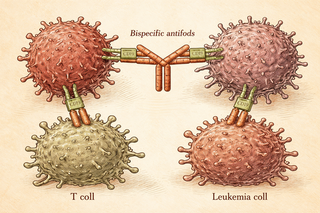
That is the tension at the heart of a new review by Paczesny and colleagues on bispecific antibodies for myeloid malignancies, especially AML - a disease where the usual immunotherapy fantasy of "just point the T cells at the bad guys" runs into an annoying biological detail: the bad guys look a lot like the good guys that make your normal blood cells (Paczesny et al., 2026).
A Very Aggressive Blind Date
Bispecific antibodies are molecular matchmakers with no respect for personal space. One end grabs a T cell, usually through CD3. The other grabs a target on the cancer cell. Result: forced proximity, immune synapse, attempted murder. Elegant in concept. Slightly unhinged in execution. Biology loves that kind of thing.
This strategy has already paid off in lymphoid cancers and myeloma, where targets can be clearer and the therapeutic window is less horrifying. But AML is a nastier evolutionary puzzle. Leukemia cells arise from the same family tree as the normal bone marrow cells you very much need for staying alive, avoiding infection, and not bleeding from brushing your teeth like you lost a knife fight with a toothbrush.
That is the central problem the review lays out. Common AML targets like CD33 and CD123 do appear on leukemia cells, but they also show up on normal hematopoietic progenitors. So a bispecific antibody can absolutely rally T cells against AML - and also against the bone marrow's civilian population. Collateral damage is not a side effect here. It is the design problem.
AML Is Not Just Evil. It Is Clever Evil.
Cancer is basically evolution with terrible ethics. In AML, clones survive because they adapt to pressure, hide in the bone marrow niche, and exploit an immune environment that often leaves T cells tired, distracted, or chemically miserable. A T cell engager sounds like a great workaround because it bypasses some of the usual "recognize me if you can" nonsense and physically drags T cells into the fight.
And there are real signs this can work.
In a phase 1/2 study of flotetuzumab, a CD123 x CD3 DART molecule, patients with primary induction failure or early relapse showed a 26.7% CR/CRh rate and a 30.0% overall response rate at the recommended phase 2 dose, with cytokine release syndrome mostly managed through step-up dosing, dexamethasone, and tocilizumab (Uy et al., 2021). In another early study, AMG 330, a CD33 x CD3 BiTE, produced complete remission or morphologic leukemia-free state in 8 of 60 evaluable patients, though cytokine release syndrome was common, showing up in 78% of treated patients (Ravandi et al., 2024).
That combination of promise and pain is the whole story right now. These drugs are not failing because the idea is dumb. They are struggling because AML is a moving target living inside a fragile organ system. It is less "sniper shot" and more "trying to remove one bad actor from a crowded elevator using a flamethrower."
The Next Trick Is Specificity, Not Just Firepower
The review's most interesting point is that the field is maturing past brute-force enthusiasm. Researchers are now obsessing over format, affinity, valency, half-life, step-up dosing, and combination strategies because the question is no longer whether T cells can kill AML. They can. The question is whether they can do it without wrecking the host or burning out themselves (Kassner et al., 2024; Goebeler et al., 2024).
One route is smarter target selection. Instead of only chasing broad myeloid markers, researchers are exploring targets with tighter leukemia bias and even intracellular antigens presented as peptide-MHC complexes. A striking example is WT1-directed bispecific work in AML, which opens the door to going after leukemia-associated proteins that do not sit conveniently on the cell surface like little "attack me" stickers (Augsberger et al., 2021).
Another route is combination therapy. Preclinical work suggests pairing T cell bispecifics with venetoclax and azacitidine could improve anti-leukemic activity while potentially reshaping the battlefield in a more favorable way (Hänel et al., 2024). Which makes sense. In evolution, pressure works best when it comes from multiple directions. Cancer cells are opportunists. Stop giving them only one door to barricade.
Why This Matters Outside the Lab
If these approaches get more precise, the real-world payoff could be huge. AML still relapses too often, still kills too many people, and still leaves clinicians choosing between treatments that are either too weak, too toxic, or both wearing different hats. A truly effective bispecific for myeloid disease would not just be another drug on a shelf. It would be proof that we can redirect immunity inside one of the body's most delicate ecosystems without smashing the furniture.
That is why this paper matters. It is not announcing victory. Frankly, AML would find that adorable and punish the optimism immediately. What it does offer is a sharp map of the battlefield: which targets look usable, which antibody formats may widen the therapeutic window, and which clinical headaches - myelotoxicity, cytokine release, antigen ambiguity, T cell exhaustion - still need solving.
For now, T cell-engaging bispecifics in AML remain a brilliant idea negotiating with brutal biology. But the negotiation is getting smarter, and in cancer, smarter often beats louder.
References
Paczesny S, Barwe SP, Gopalakrishnapillai A, Cheung NK. T cell-engaging bispecific antibodies for myeloid malignancies: Targets, formats, and clinical challenges. Cell Rep Med. 2026;7:102772. https://doi.org/10.1016/j.xcrm.2026.102772
Uy GL, Aldoss I, Foster MC, et al. Flotetuzumab as salvage immunotherapy for refractory acute myeloid leukemia. Blood. 2021;137(6):751-762. https://doi.org/10.1182/blood.2020007732
Ravandi F, Subklewe M, Walter RB, et al. Safety and tolerability of AMG 330 in adults with relapsed/refractory AML: a phase 1a dose-escalation study. Leuk Lymphoma. 2024;65(9):1281-1291. https://doi.org/10.1080/10428194.2024.2346755
Kassner J, Abdellatif B, Yamshon S, Monge J, Kaner J. Current landscape of CD3 bispecific antibodies in hematologic malignancies. Trends Cancer. 2024;10(8):708-732. https://doi.org/10.1016/j.trecan.2024.06.001
Goebeler ME, Stuhler G, Bargou R. Bispecific and multispecific antibodies in oncology: opportunities and challenges. Nat Rev Clin Oncol. 2024;21:539-560. https://doi.org/10.1038/s41571-024-00905-y
Augsberger C, Hänel G, Xu W, et al. Targeting intracellular WT1 in AML with a novel RMF-peptide-MHC-specific T-cell bispecific antibody. Blood. 2021;138(25):2655-2669. https://doi.org/10.1182/blood.2020010477. PMCID: PMC9710475
Hänel G, Schönle A, Neumann AS, et al. Combining venetoclax and azacytidine with T-cell bispecific antibodies for treatment of acute myeloid leukemia: a preclinical assessment. Leukemia. 2024;38(2):398-402. https://doi.org/10.1038/s41375-023-02127-0
Disclaimer: The image accompanying this article is for illustrative purposes only and does not depict actual experimental results, data, or biological mechanisms.