Triple-negative breast cancer, or TNBC, is the subtype that lacks estrogen receptor, progesterone receptor, and HER2 expression. In other words, it does not carry the three big molecular labels that let doctors use some of the most effective targeted breast cancer drugs. That is a major reason TNBC has a reputation for being aggressive, relapse-prone early on, and annoyingly hard to pin down with one-size-fits-all treatment strategies (Ensenyat-Mendez et al., 2021; Zhu et al., 2023).
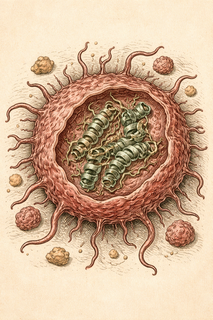
So when a study says, "Hey, we may have found a new target," people pay attention. Or at least they should, after finishing their coffee.
The weird suspect: sclerostin
Sclerostin is usually introduced in biology class as a bone protein, mostly made by osteocytes, where it helps regulate bone formation. That is already a little niche. But cancer biology loves chaos, and proteins often moonlight in places they were not invited.
This study argues that in TNBC, intracellular sclerostin - meaning the sclerostin inside the cancer cell - helps tumors grow and spread. That distinction matters. The team found that knocking out sclerostin genetically slowed tumor progression and lung metastasis, but using an antibody against extracellular sclerostin did not help. Recombinant sclerostin also did not have the expected effect. Translation: the problem may not be the protein floating around outside the cell. The troublemaker seems to be the version hanging around inside the cell, where standard antibody drugs have a much harder time reaching.
That is a pretty important twist, because extracellular sclerostin has already been discussed in bone disease and bone metastasis research before. This paper says TNBC may be running a different play entirely (Omelka et al., 2023; Sun et al., 2022).
How the tumor pulls this off
Mechanistically, the authors report that intracellular sclerostin binds to caprin1 and helps stabilize the messenger RNAs for CDK1 and Cyclin B1. If that sounds technical, here is the bar-stool version: the cancer cell is preserving the instruction notes for two major cell-cycle engines, making it easier to keep dividing.
CDK1 and Cyclin B1 are not random background extras. They are central players in pushing cells into mitosis, which is a polite scientific word for "time to split in two and make more problems." So if sclerostin is helping keep those growth instructions intact, that gives the tumor one more way to hit the gas.
The drug angle is the juicy part
The paper does not stop at "huh, that is odd." The team also tested an aptamer-based proteolysis-targeting chimera called Apc101, designed to degrade intracellular sclerostin. That is part of the broader world of targeted protein degradation, one of the more interesting drug-development ideas around right now. Instead of merely blocking a protein, you tag it for disposal. Basically, less "please stop" and more "security will escort you out" (Liu et al., 2023; Tsai et al., 2024).
In both cell-derived and patient-derived TNBC xenograft models, Apc101 significantly suppressed tumor progression. That does not mean we have a ready-for-clinic cure. Mouse models are where many beautiful ideas go to look amazing before meeting the brutal bureaucracy of human biology. Still, this is the kind of preclinical result that earns a second look.
Why this matters outside the lab
TNBC treatment has improved in recent years with immunotherapy, antibody-drug conjugates, PARP inhibitors for selected patients, and a growing pile of targeted strategies. But the disease is still heterogeneous, and metastatic TNBC remains especially difficult to control long term (Mai et al., 2023; Zhu et al., 2023).
This study matters because it points to a target that was hiding in plain sight, in a protein most people would have filed under "bone stuff" and moved on. It also reinforces a larger idea: some of the most useful cancer targets may be inside cells, doing side jobs we did not expect, and they may require smarter delivery systems than the usual antibody approach.
If these findings hold up, the real-world impact could be substantial. A drug that selectively degrades intracellular sclerostin might offer a new option for patients with TNBC, especially in tumors that depend on this pathway for growth or spread. That is still an "if." But it is a serious one.
References
-
Sun M, Luo H, Qiao S, et al. Intracellular sclerostin promotes tumor progression and metastasis as a potential therapeutic target in triple-negative breast cancer. Cell Reports Medicine. 2026;102763. DOI: 10.1016/j.xcrm.2026.102763
-
Ensenyat-Mendez M, Llinas-Arias P, Orozco JI, et al. Current Triple-Negative Breast Cancer Subtypes: Dissecting the Most Aggressive Form of Breast Cancer. Front Oncol. 2021;11:681476. DOI: 10.3389/fonc.2021.681476 PMCID: PMC8242253
-
Zhu S, Wu Y, Song B, et al. Recent advances in targeted strategies for triple-negative breast cancer. J Hematol Oncol. 2023;16:100. DOI: 10.1186/s13045-023-01497-3 PMCID: PMC10464091
-
Mai N, Abuhadra N, Jhaveri K. Molecularly Targeted Therapies for Triple Negative Breast Cancer: History, Advances, and Future Directions. Clin Breast Cancer. 2023. DOI: 10.1016/j.clbc.2023.05.012
-
Liu Y, Qian X, Ran C, et al. Aptamer-Based Targeted Protein Degradation. ACS Nano. 2023;17(7):6150-6164. DOI: 10.1021/acsnano.2c10379
-
Tsai JM, Nowak RP, Ebert BL, Fischer ES. Targeted protein degradation: from mechanisms to clinic. Nat Rev Mol Cell Biol. 2024;25:740-757. DOI: 10.1038/s41580-024-00729-9
-
Sun L, Zhang Y, Chen G, et al. Targeting SOST using a small-molecule compound retards breast cancer bone metastasis. Mol Cancer. 2022;21:233. DOI: 10.1186/s12943-022-01697-4 PMCID: PMC9798707
-
Omelka R, Mattioli-Belmonte M, Agostinelli S, et al. The link between bone-derived factors osteocalcin, fibroblast growth factor 23, sclerostin, lipocalin 2 and tumor bone metastasis. Front Endocrinol (Lausanne). 2023;14:1113547. DOI: 10.3389/fendo.2023.1113547 PMCID: PMC10012867
Disclaimer: The image accompanying this article is for illustrative purposes only and does not depict actual experimental results, data, or biological mechanisms.