Cancer drugs often fail because they pick one enemy in a room full of accomplices. That is the paradox sitting at the center of this new paper: the tumor is not just a bad cell problem, it is a bad neighborhood problem, and bringing one very stern bouncer to a riot rarely ends well.
The study, published online in ACS Nano on April 28, 2026, introduces a nanoparticle charmingly named FINAL - short for Fucoidan-docetaxel Immunomodulatory Nanoparticles as an Antitumoral Lancer.[1] Points for ambition. Also points for sounding like something a grant committee approved after coffee number four.
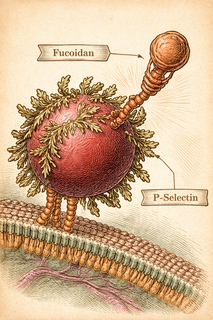
The target here is P-selectin, a sticky adhesion molecule that helps cells grab onto one another. In normal biology, that is part of how inflammation and clotting work. In cancer, of course, the system gets hijacked like every decent public utility in Gotham. P-selectin can help tumor cells interact with platelets, blood vessels, and immune cells in ways that make spread and survival easier.[2] This paper tries to exploit that same stickiness as a delivery address.
One nanoparticle, two headaches
Most cancer therapies go after tumor cells and hope the surrounding immune mess sorts itself out later. Spoiler: it usually does not. Tumors recruit tumor-associated macrophages, or TAMs, which are immune cells that should be helping clean up trouble but often end up acting like compromised local officials.[3] They can support blood vessel growth, blunt anti-tumor immunity, and make treatment response less impressive than the press release.
FINAL was designed to hit both the cancer cells and the TAMs at the same time. It carries docetaxel, a standard chemotherapy drug, but wraps it in a fucoidan-coated nanoparticle. Fucoidan is a sulfated polysaccharide from brown seaweed, and in this setup it is not just decorative kelp cosplay. It binds P-selectin and appears to have its own biologic effects, including lowering reactive oxygen species in cancer cells, nudging macrophages toward a more inflammatory M1-like state, and damping VEGF-A-linked angiogenesis.[1,4]
That is the real selling point here: this is not just drug delivery, it is drug delivery with opinions.
The tumor microenvironment is the real co-star
The paper focuses on triple-negative breast cancer, the subtype that lacks ER, PR, and HER2 targets and therefore has a longstanding habit of making oncologists earn their salaries.[5] TNBC is not impossible to treat, but it often forces clinicians into combinations of chemotherapy and immunotherapy while everyone keeps one eye on toxicity and the other on recurrence risk. It is the kind of disease that makes protocol amendments feel less like paperwork and more like emotional weather.
In mouse TNBC models, the authors report that FINAL did several useful things at once. It improved uptake into P-selectin-expressing cancer cells, disrupted adhesion between tumor cells and macrophages, reduced formation of circulating hybrid cells - weird little tumor-immune mashups linked to metastatic behavior - and shifted macrophages toward a less tumor-friendly state.[1] RNA-seq data suggested broader immune activation and suppression of tumor progression pathways.
Then came the part that makes every trialist lean forward a few inches: the in vivo outcomes. The nanoparticle reportedly doubled survival duration, reduced primary tumor growth, cut down lung metastases, and preserved bone marrow hematopoietic function better than conventional docetaxel formulations.[1] In plain English, the treatment looked more effective and less punishing. That is the oncology equivalent of hearing your flight is on time and the middle seat stayed empty.
Why this is worth watching
This study lands in a broader wave of research arguing that macrophages and the tumor microenvironment are not side quests. They are central plot devices.[3,5,6] Reviews from the past two years keep making the same point in increasingly polite academic language: if you do not rework the immune neighborhood, the tumor keeps finding ways to rent-controlled survive. Nanomedicine approaches aimed at TAM reprogramming are getting serious attention for exactly that reason.[3,6]
What makes this paper interesting is the concurrency. It does not merely poison tumor cells harder. It tries to break the social network the tumor depends on while also making the immune setting less hospitable to cancer. That is a more realistic view of how solid tumors behave.
The catch, because there is always a catch, is that this is still preclinical. Mice are useful, but they do not sign informed consent, they do not come with prior lines of therapy, and they almost never have the sort of comorbidities that make real-world oncology feel like advanced plumbing. So no, this is not ready to elbow its way into clinic tomorrow.
Still, if these findings hold up, FINAL points toward a smarter flavor of immunochemotherapy: less one-target tunnel vision, more systems thinking, and maybe fewer tradeoffs between efficacy and collateral damage. Which, in cancer drug development, counts as almost suspiciously civilized.
References
-
Lee W, Lin SL, Chen JY, et al. Concurrent P-Selectin Targeting Nanoparticle Orchestrates Tumor-Immune Dynamics for Advanced Immunochemotherapy. ACS Nano. Published online April 28, 2026. doi:10.1021/acsnano.5c15120
-
Zhao J, Huang A, Zeller J, Peter K, McFadyen JD. Decoding the role of platelets in tumour metastasis: enigmatic accomplices and intricate targets for anticancer treatments. Front Immunol. 2023;14:1256129. doi:10.3389/fimmu.2023.1256129
-
Hao J, Zhao X, Wang C, Cao X, Liu Y. Recent Advances in Nanoimmunotherapy by Modulating Tumor-Associated Macrophages for Cancer Therapy. Bioconjug Chem. 2024;35(7):867-882. doi:10.1021/acs.bioconjchem.4c00242
-
Iqbal MW, Riaz T, Mahmood S, et al. Fucoidan-based nanomaterial and its multifunctional role for pharmaceutical and biomedical applications. Crit Rev Food Sci Nutr. 2024;64(2):354-380. doi:10.1080/10408398.2022.2106182
-
Guo Z, Zhu Z, Lin X, et al. Tumor microenvironment and immunotherapy for triple-negative breast cancer. Biomark Res. 2024;12:166. doi:10.1186/s40364-024-00714-6
-
Li H, Wang S, Yang Z, Meng X, Niu M. Nanomaterials modulate tumor-associated macrophages for the treatment of digestive system tumors. Bioact Mater. 2024;36:376-412. doi:10.1016/j.bioactmat.2024.03.003 PMCID:PMC10965438
Disclaimer: The image accompanying this article is for illustrative purposes only and does not depict actual experimental results, data, or biological mechanisms.