IRS4 belongs to the insulin receptor substrate family, which sounds bland enough to be filed next to staplers.[2] In practice, these proteins help pass messages from the cell surface to growth pathways inside the cell. One of those pathways is PI3K-AKT-mTOR, the molecular equivalent of a gas pedal taped to the floorboard.[3,4]
Cancer loves that pathway. The trouble is, normal cells need parts of it too. So when we block PI3K directly, we often get a familiar oncology plotline: some benefit, plenty of side effects, and everyone arguing over glucose levels at 4:45 p.m.[4,5]
This paper asks a smarter question: instead of hitting the whole pathway with a frying pan, can we find a weird little upstream component that only certain tumors depend on?
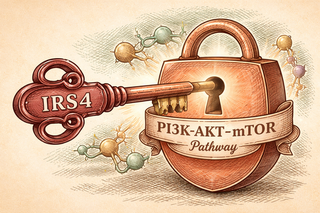
Enter IRS4.
How Tumors Turn On the Weird Gene
The authors did not just hunt for genes cancer cells need. They specifically looked for targets with a shot at a good therapeutic index - meaning strong effect on cancer, limited collateral damage to normal tissue.[1] That alone deserves a slow clap. Drug development has often handled toxicity the way students handle taxes: later, with dread.
They found that IRS4 shows up in several tumor types, including pediatric choroid plexus tumors, malignant rhabdoid tumors, NUT carcinoma, some osteosarcomas, and smaller subsets of adult cancers such as breast, lung, stomach, and uterine tumors.[1] Not everywhere. This is not a universal cancer key. It is more like a very specific lockpick.
And the way tumors switch IRS4 on is part of the fun, if your idea of fun includes genome architecture misbehaving in public. In some adult cancers, IRS4 expression was tied to enhancer hijacking - DNA rearrangements that drag powerful regulatory elements next to the wrong gene and basically yell, "Congratulations, you work nights now."[1,6] In rhabdoid and NUT tumors, IRS4 seemed to be activated through epigenetic mechanisms instead.[1]
So the cancer cell is not inventing a new pathway. It is rummaging through the junk drawer and finding a way to overuse an existing one. Very on brand.
Why IRS4 Is More Than a Random Blob of Letters
This is not the first hint that IRS4 can behave badly. Earlier studies showed IRS4 can keep PI3K-AKT signaling active in ways that promote tumor growth and drug resistance, including in breast and ovarian cancer models.[2,3,7] What this new study adds is scale and selectivity. It argues IRS4 is not just biologically interesting. It may be a real dependency in defined cancer subsets.[1]
Even better, when the researchers removed or degraded IRS4, the IRS4-expressing cancer cells struggled to grow.[1] That is the sort of finding that makes medicinal chemists sit up straighter.
There is also an awkward little twist that makes this more interesting: the predicted druggable pocket sits in domains the tumor may not actually need for IRS4’s cancer-promoting function.[1] Annoying? Yes. Fatal? Not necessarily. It points toward targeted protein degradation rather than simple blockade. In other words, maybe do not gum up the machine - throw the machine out a window.
Why This Matters Outside a Lab Meeting
If these findings hold up, IRS4 could become the kind of biomarker-defined target oncologists actually want: rare, specific, mechanistically sensible, and maybe safer than smashing the entire PI3K axis.[1,4,5]
That matters most in diseases where the treatment margin is already miserable, especially pediatric tumors. The dream here is not "a cure for cancer," because we are adults and we have seen brochures. The dream is narrower and more useful: find the small group of patients whose tumors are addicted to IRS4, and hit that addiction hard without torching the rest of the body.
That said, this is still preclinical territory. Plenty of targets look fabulous right up until a real drug meets a real human and everything gets humbling fast. Cancer has a PhD in backup plans.
Still, IRS4 has the right kind of oddness. Not famous. Not everywhere. Apparently very handy to the wrong cells at the wrong time. Oncology has seen worse candidates. Usually before lunch.
References
-
Banu K, Khan MA, Li S, et al. IRS4 is a PI3K-activating cancer dependency up-regulated through DNA rearrangements or epigenetic mechanisms in multiple solid tumors. Science Advances. 2026;12(18):eaeb3503. DOI: 10.1126/sciadv.aeb3503. PubMed: 42054459
-
Guijarro LG, Justo Bermejo FJ, Boaru DL, et al. Is Insulin Receptor Substrate4 (IRS4) a Platform Involved in the Activation of Several Oncogenes? Cancers (Basel). 2023;15(18):4553. DOI: 10.3390/cancers15184553. PMCID: PMC10526421
-
Zhang Y, Xiong X, Zhu Q, et al. FER-mediated phosphorylation and PIK3R2 recruitment on IRS4 promotes AKT activation and tumorigenesis in ovarian cancer cells. eLife. 2022;11:e76183. DOI: 10.7554/eLife.76183. PMCID: PMC9098222
-
Belli C, Repetto M, Anand S, et al. The emerging role of PI3K inhibitors for solid tumour treatment and beyond. British Journal of Cancer. 2023;128:2150-2162. DOI: 10.1038/s41416-023-02221-1
-
Llorente A, Arora GK, Murad R, et al. Phosphoinositide kinases in cancer: from molecular mechanisms to therapeutic opportunities. Nature Reviews Cancer. 2025;25:463-487. DOI: 10.1038/s41568-025-00810-1. PubMed: 40181165
-
Liu T, Wang J, Yang H, et al. Enhancer Coamplification and Hijacking Promote Oncogene Expression in Liposarcoma. Cancer Research. 2023;83(9):1517-1530. DOI: 10.1158/0008-5472.CAN-22-1858. PMCID: PMC10152236
-
Vervoort SJ, van Boxtel R, Coffer PJ. Insulin receptor substrate 4 (IRS4) is a constitutive active oncogenic driver collaborating with HER2 and causing therapeutic resistance. Proceedings of the National Academy of Sciences USA. 2017;114(9):E1833-E1842. DOI: 10.1073/pnas.1700715114. PubMed: 28401183
Disclaimer: The image accompanying this article is for illustrative purposes only and does not depict actual experimental results, data, or biological mechanisms.